
Constantin BrâncuÈ™i (Romanian: [konstanˈtin brɨŋˈkuʃʲ]; February 19, 1876 â€" March 16, 1957) was a Romanian sculptor, painter and photographer who made his career in France. Considered a pioneer of modernism, one of the most influential sculptors of the 20th-century, BrâncuÈ™i is called the patriarch of modern sculpture. As a child he displayed an aptitude for carving wooden farm tools. Formal studies took him first to Bucharest, then to Munich, then to the École des Beaux-Arts in Paris from 1905 to 1907. His art emphasizes clean geometrical lines that balance forms inherent in his materials with the symbolic allusions of representational art. BrâncuÈ™i sought inspiration in non-European cultures as a source of primitive exoticism, as did Paul Gauguin, Pablo Picasso, André Derain and others. But other influences emerge from Romanian folk art traceable through Byzantine and Dionysian traditions.
Early years
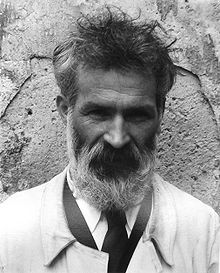
Brâncuși grew up in the village of Hobiţa, Gorj, near Târgu Jiu, close to Romania's Carpathian Mountains, an area known for its rich tradition of folk crafts, particularly woodcarving. Geometric patterns of the region are seen in his later works.
His parents Nicolae and Maria Brâncuși were poor peasants who earned a meager living through back-breaking labor; from the age of seven, Constantin herded the family's flock of sheep. He showed talent for carving objects out of wood, and often ran away from home to escape the bullying of his father and older brothers.
At the age of nine, Brâncuși left the village to work in the nearest large town. At 11 he went into the service of a grocer in Slatina; and then he became a domestic in a public house in Craiova where he remained for several years. When he was 18, Brâncuși created a violin by hand with materials he found around his workplace. Impressed by Brâncuși's talent for carving, an industrialist entered him in the Craiova School of Arts and Crafts (școala de arte și meserii), where he pursued his love for woodworking, graduating with honors in 1898.
He then enrolled in the Bucharest School of Fine Arts, where he received academic training in sculpture. He worked hard, and quickly distinguished himself as talented. One of his earliest surviving works, under the guidance of his anatomy teacher, Dimitrie Gerota, is a masterfully rendered écorché (statue of a man with skin removed to reveal the muscles underneath) which was exhibited at the Romanian Athenaeum in 1903. Though just an anatomical study, it foreshadowed the sculptor's later efforts to reveal essence rather than merely copy outward appearance.
Working in Paris

In 1903, Brâncuși traveled to Munich, and from there to Paris. In Paris, he was welcomed by the community of artists and intellectuals brimming with new ideas. He worked for two years in the workshop of Antonin Mercié of the École des Beaux-Arts, and was invited to enter the workshop of Auguste Rodin. Even though he admired the eminent Rodin he left the Rodin studio after only two months, saying, "Nothing can grow under big trees."
After leaving Rodin's workshop, Brâncuși began developing the revolutionary style for which he is known. His first commissioned work, "The Prayer", was part of a gravestone memorial. It depicts a young woman crossing herself as she kneels, and marks the first step toward abstracted, non-literal representation, and shows his drive to depict "not the outer form but the idea, the essence of things." He also began doing more carving, rather than the method popular with his contemporaries, that of modeling in clay or plaster which would be cast in metal, and by 1908 he worked almost exclusively by carving.
In the following few years he made many versions of "Sleeping Muse" and "The Kiss", further simplifying forms to geometrical and sparse objects.
His works became popular in France, Romania and the United States. Collectors, notably John Quinn, bought his pieces, and reviewers praised his works. In 1913 Brâncuși's work was displayed at both the Salon des Indépendants and the first exhibition in the U.S. of modern art, the Armory Show.
In 1920, he developed a notorious reputation with the entry of "Princess X" [1] in the Salon. The phallic shape of the piece scandalized the Salon, and despite Brâncuși's explanation that it was an anonymous portrait, removed it from the exhibition. "Princess X" was revealed to be Princess Marie Bonaparte, direct descendant of the younger brother of Napoleon Bonaparte. Brâncuși represented or caricatured her life as a large gleaming bronze phallus. This phallus symbolizes the model's obsession with the penis and her lifelong quest to achieve vaginal orgasm, with the help of Sigmund Freud.
Around this time he began crafting the bases for his sculptures with much care and originality because he considered them important to the works themselves.
He began working on the group of sculptures that are known as "Bird in Space" â€" simple shapes representing a bird in flight. The works are based on his earlier "Măiastra" [2] series. In Romanian folklore the Măiastra is a beautiful golden bird who foretells the future and cures the blind. Over the following 20 years, BrâncuÈ™i would make 20-some versions of "Bird in Space" out of marble or bronze. Photographer Edward Steichen purchased one of the "birds" in 1926 and shipped it to the United States. However, the customs officers did not accept the "bird" as a work of art and placed a duty upon its import as an industrial item. They charged the high tax placed upon raw metals instead of the no tax on art. A trial the next year overturned the assessment. Athena Tacha Spear's book, BrâncuÈ™i's Birds, (CAA monographs XXI, NYU Press, New York, 1969), first sorted out the 36 versions and their development, from the early Măiastra, to the Golden Bird of the late teens, to the Bird in Space, which emerged in the early '20s and which BrâncuÈ™i perfected throughout his life.
His work became popular in the U.S., however, and he visited several times during his life. Worldwide fame in 1933 brought him the commission of building a meditation temple in India for Maharajah of Indore, but when Brâncuși went to India in 1937 to complete the plans and begin construction, the Mahrajah was away and lost interest in the project when he returned.
In 1938, he finished the World War I monument in Târgu-Jiu where he had spent much of his childhood. "Table of Silence", "The Gate of the Kiss", and "Endless Column" commemorate the courage and sacrifice of Romanian's who in 1916 defended Târgu Jiu from the forces of the Central Powers. The restoration of this ensemble was spearheaded by the World Monuments Fund and was completed in 2004.
The Târgu Jiu ensemble marks the apex of his artistic career. In his remaining 19 years he created less than 15 pieces, mostly reworking earlier themes, and while his fame grew he withdrew. In 1956 Life magazine reported, "Wearing white pajamas and a yellow gnomelike cap, Brâncuși today hobbles about his studio tenderly caring for and communing with the silent host of fish birds, heads, and endless columns which he created."
Brâncuși was cared for in his later years by a Romanian refugee couple. He became a French citizen in 1952 in order to make the caregivers his heirs, and to bequeath his studio and its contents to the Musée National d'Art Moderne in Paris
Personal life
Brâncuși always dressed in the simple ways the Romanian peasants did. His studio was reminiscent of the houses of the peasants from his native region: there was a big slab of rock as a table and a primitive fireplace, similar to those found in traditional houses in his native Oltenia, while the rest of the furniture was made by him out of wood. Brâncuși would cook his own food, traditional Romanian dishes, with which he would treat his guests.
Brâncuși held a large spectrum of interests, from science to music. He was a good violinist and he would sing old Romanian folk songs, often expressing by them his feelings of homesickness. After the installment of communism, he never considered moving back to his native Romania, but he did visit it eight times.
His circle of friends included artists and intellectuals in Paris such as Amedeo Modigliani, Ezra Pound, Henri Pierre Roché, Guillaume Apollinaire, Louise Bourgeois, Pablo Picasso, Man Ray, Marcel Duchamp, Henri Rousseau, and Fernand Léger. He was an old friend of Romany Marie, who was also Romanian, and referred Isamu Noguchi to her café in Greenwich Village. Although surrounded by the Parisian avant-garde, Brâncuși never lost the contact with Romania and had friends from the community of Romanian artists and intellectuals living in Paris, including Benjamin Fondane, George Enescu, Theodor Pallady, Camil Ressu, Nicolae Dărăscu, Panait Istrati, Traian Vuia, Eugène Ionesco, Emil Cioran and Paul Celan.
Brâncuși held a particular interest in mythology, especially Romanian mythology, folk tales, and traditional art (which also had a strong influence on his works), but he became interested in African and Mediterranean art as well.
A talented handyman, he built his own phonograph, and made most of his furniture, utensils, and doorways. His worldview valued "differentiating the essential from the ephemeral," with Plato, Lao-Tzu, and Milarepa as influences. He was a saint-like idealist and near ascetic, turning his workshop into a place where visitors noted the deep spiritual atmosphere. However, particularly through the 10s and 20s, he was known as a pleasure seeker and merrymaker in his bohemian circle. He enjoyed cigarettes, good wine, and the company of women. He had one child, John Moore, whom he never acknowledged.
Death and legacy
Brâncuși died on March 16, 1957, aged 81. He was buried in the Cimetière du Montparnasse in Paris. This cemetery also displays statues that Brâncuși carved for deceased artists.
In 1962, Georg Olden used Brâncuși's Bird in Space as the inspiration behind his design of the Clio Award statuette.
At his death Brâncuși left 1200 photographs and 215 sculptures. He bequeathed part of his collection to the French state, after it was refused by the Romanian Communist government, on condition that his workshop be rebuilt as it was on the day he died. This reconstruction of his studio, adjacent to the Pompidou Centre, is open to the public. Brâncuși's studio inspired Swedish architect Klas Anshelm's design of the Malmö Konsthall, which opened in 1975.
Brâncuși was elected posthumously to the Romanian Academy in 1990. Brâncuși's piece "Madame L.R." sold for €29.185 million ($37.2 million) in 2009, setting a record price for a sculpture sold at auction. Google commemorated his 135th birthday with a Doodle in 2011 consisting of seven of his works.
Brâncuși's works are housed in the National Museum of Art of Romania (Bucharest), the Museum of Modern Art (New York) and other museums around the world. The Philadelphia Museum of Art holds the largest collection of Brâncuși sculptures in the United States.
Brâncuși on his own work

Selected works

Both Bird in Space and Sleeping Muse I are sculptures of animate objects; however, unlike ones from Ancient Greece or Rome, or those from the High Renaissance period, these works of art are more abstract in style.
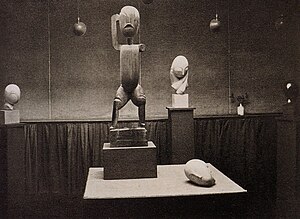
Bird in Space is a series from the 1920s. One of these, constructed in 1925 using wood, stone, and marble (Richler 178) stands around 72 inches tall and consists of a narrow feather standing erect on a wooden base. Similar models, but made from materials such as bronze, were also produced by Brâncuși and placed in exhibitions.
Sleeping Muse I has different versions as well; one, from 1909â€"10, is made of marble and measures 6 ¾ in. in height (Adams 549). This is a model of a head, without a body, with markings to show features such as hair, nose, lips, and closed eyes. In A History of Western Art, Adams says that the sculpture has “an abstract, curvilinear quality and a smooth contour that create an impression of elegance†(549). The qualities which produce the effect can particularly be seen in the shape of the eyes and in the set of the mouth.
Other works

In fiction
- In Evelyn Waugh's novel Brideshead Revisited, Anthony Blanche remarks in relating a story to Charles Ryder that "I have two sculptures by Brancusi and several pretty things" [sic].
- In the 1988 movie Short Circuit 2, a man walking through an outdoor exhibition speculates that the stationary Johnny 5 robot, who is also admiring the exhibit, is "an early Brâncuși."
- In the 1999 science fiction series Total Recall 2070, one episode ("Astral Projections") featured an artifact called the Brancusi Stone because it looks like one of Brâncuși's sculptures.
- In the 2000 film Mission to Mars, the "Face on Mars" is modeled after Brâncuși's "Sleeping Muse".
References

Bibliography

- Tom Sandqvist, Dada East â€" The Romanians of Cabaret Voltaire, MIT Press, 2006, ISBN 0-262-19507-0
- Adams, Laura S. A History of Western Art. 4th ed. New York: McGrawâ€"Hill, 2005.
- Richler, Martha. National Gallery of Art, Washington: A World of Art. London: Scala Books, 1998.
- Neutres, Jerome. Brâncuși New York, 1913-2013. New York: Editions Assouline, 2014. ISBN 9781614281962
External links
- Support for the inclusion of Heroes’ Way, the most prominent monumental ensemble in the region as well as one of Brâncusi’s major creations, in the list of UNESCO World Heritage Sites
- An excerpt from the transcript of Brâncuși versus United States
- Brâncuși in the Philadelphia Museum of Art
- Brâncuși in the Guggenheim Museum.
- Constantin Brâncuși at the Museum of Modern Art
- Peggy Guggenheim Collection
- Public domain image resources
- Brâncuși's atelier at Centre Pompidou, France
- Petre ÈšuÈ›ea â€" An encounter with BrâncuÈ™i a rare meeting between two unusual personalities